
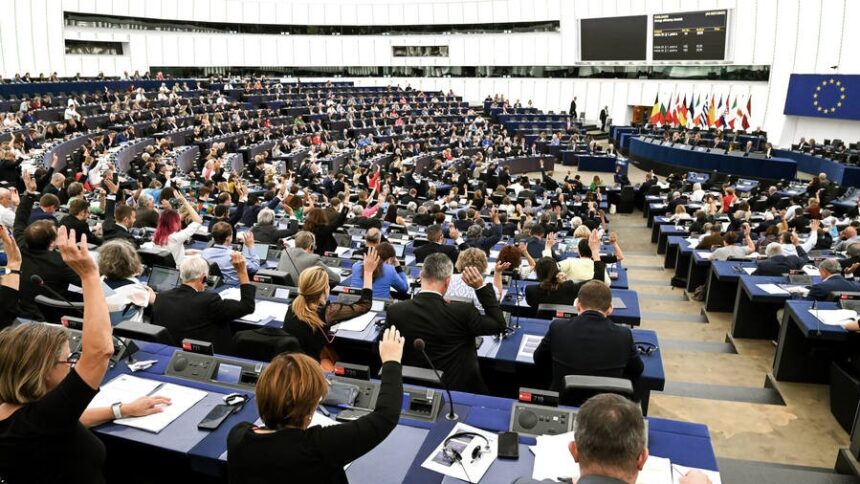
On the plenary in Strabourg MEPs endorsed the proposal that all EU Member States and NATO allies should provide military support to Ukraine amounting to at least 0.25% of their annual GDP.
In the resolution they adopted on the occasion of the two-year anniversary of the Russian invasion of Ukraine (451 votes in favour, 46 against and 49 abstentions), MEPs believe that “there should be no self-imposed restriction on military assistance to Ukraine” and that the main objective of Ukraine winning the war “can be met only through the continued, sustained and steadily increasing supply of all types of conventional weapons to Ukraine, without exception”. They are therefore once again calling on the Member States to “significantly” increase their military support.
Parliament is calling for the necessary investment to be made in the European defence industrial base so that production can be increased “considerably” to meet Ukraine’s needs and replenish Member States’ depleted stocks.
Looking beyond the military aspect, while welcoming the agreement in principle on the ‘Ukraine Facility’, MEPs believe that the funds are insufficient and are calling on the EU and its Member States to commit to providing additional long-term funding for Ukraine.
MEPs also call for the adoption of additional sanctions against Russia and Belarus, the proper application of measures already adopted and sanctions against those involved in circumventing them. In Parliament’s view, there is also an urgent need to establish a solid legal regime enabling Russian assets frozen by the EU to be confiscated and used.
Furthermore, Parliament welcomes the decision to open accession negotiations with Ukraine, calling on the Council to instruct the Commission to present proposals immediately on the appropriate negotiating framework and to adopt them once the appropriate measures have been set out in the relevant Commission recommendations of 8 November 2023.
More Read

EUBriefs
Des journalistes européens ainsi que d’autres provenant de pays en dehors de l’Union européenne contribuent également aux contenus publiés par EUbriefs. EUbriefs publie des articles provenant de diverses sources externes qui reflètent un large éventail de points de vue. Les opinions exprimées dans ces articles ne reflètent pas nécessairement celles d’EUbriefs. EUbriefs utilise l’intelligence artificielle comme outil pour améliorer la qualité, l’efficacité et l’accessibilité du journalisme, tout en maintenant une supervision éditoriale humaine stricte, le respect des normes éthiques et une transparence totale dans tous les contenus assistés par l’IA.