
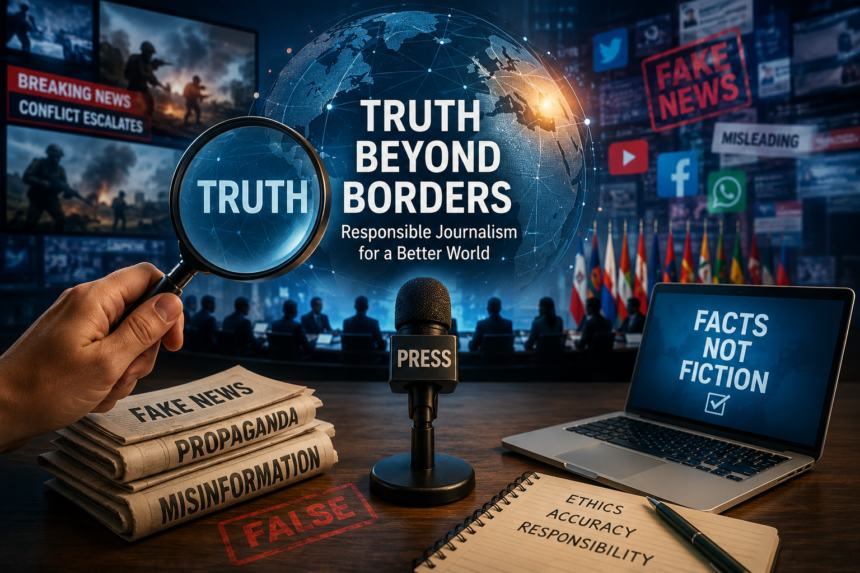
In an age of digital communication and instant information sharing, the role of media has become more significant than ever before. In an increasingly volatile information environment where narratives shape geopolitical realities, the challenge of disinfornation especially in conflict reporting has engaged as a critical concern.
The fast spread of misinformation made it difficult for people to distinguish between facts and propaganda. News channels and social media users often shared emotional and nationalistic content without proper verification. As a result, mistrust and hostility grew on both sides.
This situation highlighted the importance of responsible journalism, fact-checking, and peaceful communication during times of conflict. The events of the five-day war demonstrated how misinformation can influence public opinion and worsen political tensions. It also showed that media has a great responsibility to promote truth and accuracy instead of spreading fear and accusations.
The international webinar titled “Truth Beyond Borders,” organized by the Ministry of Information and Broadcasting of Pakistan, highlighted the importance of truthful journalism, responsible communication, and international cooperation in combating misinformation. The webinar brought together journalists, scholars, policymakers, and media professionals from different parts of the world to discuss the challenges and responsibilities of media in the modern era.
Le thème « La vérité au-delà des frontières » reflète l’idée que la vérité est universelle et ne devrait pas être limitée par la géographie, la politique ou les différences culturelles. Dans le monde interconnecté d’aujourd’hui, l’information circule rapidement à travers les pays et les continents. Si cela favorise une meilleure sensibilisation et une meilleure compréhension, cela accroît également la propagation de fausses nouvelles, de propagande et d’informations trompeuses. C’est pourquoi le webinaire a souligné l’urgence d’un journalisme éthique et d’une information factuelle.
More Read
One of the major topics discussed during the webinar was the impact of social media on public opinion. Social media platforms have become powerful tools for communication, but they can also be used to spread rumors and hatred. Speakers in the webinar stressed that media organizations and journalists must verify information carefully before sharing it with the public. Responsible journalism is essential for maintaining public trust and promoting peace and stability in society.
Another important aspect of the webinar was the promotion of international dialogue and cooperation. The participation of experts and media professionals from different countries demonstrated the value of exchanging ideas and experiences. Such discussions help nations understand each other better and encourage mutual respect. By working together, countries can develop strategies to fight disinformation and promote accurate reporting.
The webinar also highlighted Pakistan’s efforts to promote responsible media practices and freedom of expression. The Ministry of Information and Broadcasting emphasized that media should serve as a bridge between cultures rather than a source of division. In this context, truth and transparency are essential for strengthening democracy, protecting human rights, and ensuring informed public participation.
More Read

Furthermore, the event underlined the importance of educating young people about media literacy. In the digital age, individuals must learn how to identify reliable sources of information and critically analyze the content they consume online. Media literacy can help citizens avoid manipulation and make informed decisions.
The “Truth Beyond Borders” seminar organised by the Ministry of Information and Broadcasting of Pakistan was a meaningful initiative of the that addressed one of the most important issues of the modern world: the protection of truth in global communication. The webinar encouraged journalists, governments, and citizens to work together in promoting honesty, responsibility, and understanding through media. By supporting ethical journalism and international cooperation, societies can build a more informed, peaceful, and connected world.
EUBriefs
Des journalistes européens ainsi que d’autres provenant de pays en dehors de l’Union européenne contribuent également aux contenus publiés par EUbriefs. EUbriefs publie des articles provenant de diverses sources externes qui reflètent un large éventail de points de vue. Les opinions exprimées dans ces articles ne reflètent pas nécessairement celles d’EUbriefs. EUbriefs utilise l’intelligence artificielle comme outil pour améliorer la qualité, l’efficacité et l’accessibilité du journalisme, tout en maintenant une supervision éditoriale humaine stricte, le respect des normes éthiques et une transparence totale dans tous les contenus assistés par l’IA.