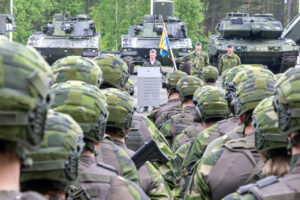


CIA Director John Ratcliffe’s visit to Moscow has focused attention on the military problem NATO would face if Russia attempted a limited operation against the Baltic states. The reported US warning does not mean an attack has been ordered, but it suggests Washington is treating the possibility of a deliberate test of the Alliance’s eastern flank as a credible contingency.
CIA Director John Ratcliffe warned Russian officials against military escalation involving NATO members during his visit to Moscow on 25 August, with Estonia, Latvia and Lithuania reportedly a particular focus of the discussions.
According to people familiar with the talks, one of the principal purposes of Ratcliffe’s mission was to warn Moscow against action targeting NATO territory. The available reporting does not establish that Russia has decided to attack the Baltic states, nor that an operation is imminent.
Russian Foreign Intelligence Service director Sergei Naryshkin subsequently confirmed that he held a working-level meeting with Ratcliffe. The Kremlin has disclosed little about the substance of the discussions and said Ratcliffe did not meet President Vladimir Putin, although Putin was briefed on the talks.
For defence planners, however, the significance lies less in the diplomatic format than in the scenario Washington apparently considered serious enough to address directly.
A limited operation would pose a different military problem
A Russian attack against Estonia, Latvia or Lithuania would differ fundamentally from the invasion of Ukraine in February 2022. All three are NATO members and are incorporated into Alliance defence planning, reinforcement structures and forward deployments.
More Read

NATO currently maintains nine multinational Forward Land Forces battlegroups along its eastern flank, including formations in Estonia, Latvia and Lithuania.
The United Kingdom serves as framework nation for the formation in Estonia, Canada leads the presence in Latvia and Germany provides the framework for Lithuania. These units operate alongside the host countries’ armed forces and are intended to ensure that any attack immediately involves personnel from several Allied states.
That arrangement is designed partly to remove the possibility that Moscow could regard an attack on a small NATO member as a bilateral conflict that could be contained before other Allies became involved.
More Read
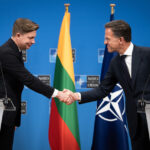
Since Russia’s full-scale invasion of Ukraine, NATO has also changed its force posture from relatively small forward deployments towards a model combining forces already in theatre with pre-assigned reinforcements, equipment stocks and regional defence plans.
The Alliance says its forward battlegroups can be scaled towards brigade strength where required, while larger high-readiness forces are intended to reinforce them during a crisis.
Geography remains the central constraint
The Baltic theatre nevertheless presents difficult operational conditions.
Estonia and Latvia share substantial land borders with Russia. Lithuania lies between Belarus and Russia’s heavily militarised Kaliningrad exclave, which hosts elements of the Baltic Fleet and Russian missile and air-defence capabilities.
The Baltic states are connected to the rest of NATO territory by the comparatively narrow Polish-Lithuanian frontier between Kaliningrad and Belarus, commonly referred to as the Suwałki corridor.
In a major conflict, NATO would therefore need to protect reinforcement routes simultaneously across land, air and the Baltic Sea while countering Russian long-range fires, air defence, electronic warfare and potentially attacks against logistics infrastructure.
More Read

That makes rapid reinforcement, air and missile defence, ammunition availability and command-and-control resilience at least as important as the number of troops permanently stationed in the region.
NATO has consequently continued to strengthen its eastern posture. Its current plans include pre-positioned equipment, additional integrated air and missile defence, strengthened command structures and forces assigned in advance to particular regional defence plans.
The Alliance has also introduced additional activities in the region following repeated security incidents. Baltic Sentry was established to protect critical infrastructure in the Baltic Sea, while Eastern Sentry was subsequently introduced to strengthen the eastern flank following Russian airspace violations.
The danger of a deliberately limited test
The most difficult scenario may not be a large Russian offensive resembling the opening phase of the Ukraine war.
A geographically limited incursion, hybrid attack or combined operation could instead be designed to create political uncertainty over the appropriate Allied response before NATO could establish the scale and objectives of the action.
Such an operation would still risk invoking Article 5, but Article 5 does not prescribe an automatic or identical military response from each member. NATO’s deterrence therefore relies not only on treaty language but on convincing Moscow that Allied governments would respond rapidly and collectively.
The presence of multinational units in the Baltic states is intended to strengthen precisely that calculation.
Ratcliffe’s Moscow mission also recalls the November 2021 visit by his predecessor, William Burns. Burns was sent by the Biden administration after US intelligence identified Russian preparations for an invasion of Ukraine. He later said his task was to explain what Washington knew about Moscow’s preparations and the consequences of proceeding.
The comparison has limits. Ukraine was not covered by NATO’s collective-defence arrangements, whereas Russian action against the Baltic states would confront an established Allied military presence from the opening stage of any conflict.
President Donald Trump has described Ratcliffe’s visit as “semi-routine” and rejected suggestions that it was specifically prompted by an imminent Russian move against NATO.
The reported warning therefore should not be interpreted as evidence that an attack has been scheduled. Its importance is that the possibility of Russian action against NATO territory appears to have moved high enough on the US security agenda to warrant direct communication between the CIA director and Russia’s intelligence leadership.
For NATO’s eastern flank, that places renewed emphasis on the central problem of deterrence: ensuring that Moscow sees no plausible route to a rapid, geographically limited military success before Allied reinforcements can arrive.
Source : https://defencematters.eu/ratcliffe-moscow-baltic-nato-deterrence-warning/
EUBriefs
Des journalistes européens ainsi que d’autres provenant de pays en dehors de l’Union européenne contribuent également aux contenus publiés par EUbriefs. EUbriefs publie des articles provenant de diverses sources externes qui reflètent un large éventail de points de vue. Les opinions exprimées dans ces articles ne reflètent pas nécessairement celles d’EUbriefs. EUbriefs utilise l’intelligence artificielle comme outil pour améliorer la qualité, l’efficacité et l’accessibilité du journalisme, tout en maintenant une supervision éditoriale humaine stricte, le respect des normes éthiques et une transparence totale dans tous les contenus assistés par l’IA.