
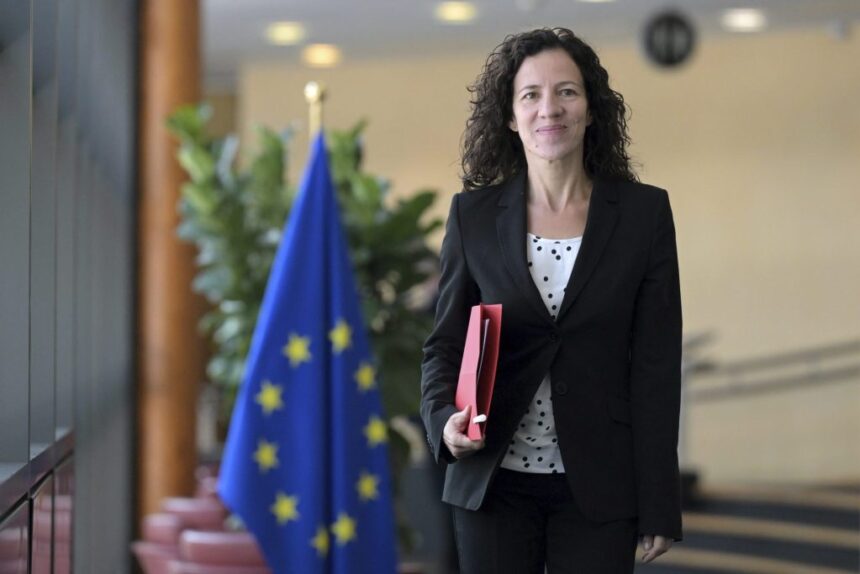
Today (10 March) Quality Jobs and Social Rights, Education, Skills and Preparedness Executive Vice President Roxana Mînzatu (pictured) will take part in the meeting of employment and social affairs ministers (EPSCO) in Brussels.
In the morning, ministers will discuss the European Semester, the EU’s framework to coordinate economic, employment, and social policies. They are set to finalize their position on the employment and social aspects of 2025 eurozon economic policy recommendation, and on the Commission’s proposal for the 2025 Joint Employment Report. They will also issue their conclusions on this report.
Ministers will also debate how to tackle labour and skills shortages due to an ageing population, and remove barriers preventing older people from staying in or rejoining the workforce. In this context, Executive Vice-President Mînzatu will present the Union of Skills, the Commission’s strategy to support the development of Europe’s human capital, including lifelong learning and talent attraction and retention measures.
Executive Vice-President Mînzatu will also inform ministers about the Pact for European Social Dialogue, signed last week by the Commission and the European social partners, and about the upcoming Tripartite Social Summit, taking place in Brussels on 19 March.
Over lunch, ministers will hold an informal debate on the right to disconnect. In April 2024, the Commission had launched a first-stage consultation on this matter.
More Read

Parts of the meeting can be followed online. A joint press conference with Executive Vice-President Mînzatu and Polish Minister for Family, Labour and Social policy, Agnieszka Dziemianowicz-Bąk, will take place at +/- 14.45 CET and it can be followed live.
BY James Drew
EUBriefs
Des journalistes européens ainsi que d’autres provenant de pays en dehors de l’Union européenne contribuent également aux contenus publiés par EUbriefs. EUbriefs publie des articles provenant de diverses sources externes qui reflètent un large éventail de points de vue. Les opinions exprimées dans ces articles ne reflètent pas nécessairement celles d’EUbriefs. EUbriefs utilise l’intelligence artificielle comme outil pour améliorer la qualité, l’efficacité et l’accessibilité du journalisme, tout en maintenant une supervision éditoriale humaine stricte, le respect des normes éthiques et une transparence totale dans tous les contenus assistés par l’IA.